Your Values Don't Count Until They Cost You
An ISO 42001 Lead Auditor on why every automated decision needs a human in the loop, plus the four-move Hinge Check framework.

What a Roman emperor and a grieving king teach about the one job no machine can do for you.
I believe in human rights, freedom of expression, dignity and compassion.
You can see I have a laundry list of values, and they're super important to me. Most people have a list like it. Most of us would even sign each other's.
What matters more is what I've learned to practice. Some of the most heinous acts of evil and pain that human beings have inflicted on other human beings taught me this: my values mean nothing if I only want to extend them to people I like.
The Easy Part Is the List
Most of us probably agree on the core issues.
My values only matter when I'm willing to extend them to people I don't agree with and people I actually dislike/can’t stand and where their mere presence has me immediately looking for an exit because every moment in shared space I literally feel dumber. That's the crux of it.
I read the Stoics the way most people scroll through Instagram, so I know I'm in old company here. Marcus Aurelius opens Book 2 of his Meditations by telling himself what the day will bring. He'll meet "the busy-body, the ungrateful, arrogant, deceitful, envious, unsocial." Well, yes, Marcus, that sounds like my Tuesday.
Then he does the thing I'm still learning how to do. He reminds himself that the person doing him wrong is his own kin, and that people are made to work together like a pair of hands. This is a Roman emperor writing notes to himself. In Book 6 he says the one thing worth a great deal is to live in truth and justice and stay kind even to liars and unjust men. Ugh, Marcus, you're making this hard. People.
If liars made his list, the coworker who talks over you and the one who steals credit for your work can most definitely can make yours.
Dignity Comes with Receipts
Extending dignity to someone I dislike is one thing. And as you can see, I'm still struggling with that. Excusing what they do is another, and I won't. Nope.
Do not pass Go, do not collect $200.
Keeping quiet to keep the peace? No!
Participation prizes where everyone gets a trophy can go too, along with coddling stupidity.
And I will never ever excuse emotionally bankrupt, morally corrupt behavior because the person doing it is rich. Full stop.
Seneca had that one covered about 2,000 years ago. In Of a Happy Life he says riches can't be a real good, because if they were, they'd make people good. Now, look around and tell me how that's working out. Yeah, it's not. In the same chapter he writes the line I try to live by: "Wherever there is a human being, there is an opportunity for a benefit." He left off the part about liking them first.
So, I do both. Sure, I can see your humanity but I’m still gonna read you your receipts. Marcus gave himself the same instruction in Book 8: "Teach them then or bear with them." Staying quiet didn't make his list of options either. So, there’s that.
Now, I realize a lot of today’s politics heads the other way, and "a lot" is doing the heaviest of lifting here. Clickbait pays for the cheap shot and for turning a person into a label. If we keep playing along, the gaps between us keep deepening, and the misunderstanding and the dehumanizing of ourselves and each other continue at scale. I'm not willing to contribute to that. I refuse to.
The only way I know how to disrupt it is through more humanness. Marcus said it shorter in Book 6: "The best way of avenging thyself is not to become like the wrong doer."
Have Backbone
I got to practice this out loud a few days ago. At the Frontier Summit in Vancouver, a former Amazon leader delivered a keynote where he told a room of founders to disagree and commit.
Ok, former Amazonian here. That principle has a first half, and the first half is the damn lesson.
Amazon's own name for it is "Have Backbone; Disagree and Commit." It says leaders are obligated to challenge what they disagree with, and that they don't trade conviction for a comfortable room. Leave off the backbone and all you've taught people is how to go along to get along and be liked.
So, I said so. Disagree and commit means committing to why everyone at that summit was there. For a founder, that can mean walking away from the client or the funding that costs you your values.
I also told that room something people usually save for the hallway. There are a few people in this room committed to ensuring that concentrated power and wealth remain with the few who have them. They're the ones making decisions that land on all of us, including decisions about risk, and they have no skin in our game.
Then at the break someone asked me where I got my values. This is what I said:
"I live my life committed to leaving people and places better than I found them. I know what it's like to be excluded under the guise of included but never belonging. I know what it's like not to have someone who just wants you to have better and be better. My values are simple. Treat people how you want to be treated. And what a world this would be if everyone did just that?"
Everyone means everyone. It covers the people I can't stand, and it covers the few asshats making those decisions. I can treat them the way I'd want to be treated and still tell a full room what they're doing.
A King Figured This Out on Clay Tablets
This week Rohun Shroff opened The AI Pulse with a line he credits to Simone de Beauvoir: we start dying the minute we're born, and life is what happens between. He calls that stretch the messy in-between, and I haven't stopped thinking about it.
People have been wrestling with it for about FOREVER. The oldest Gilgamesh poems may go back to around 2100 BCE.
Here’s the crib notes version. Gilgamesh is king of Uruk, two-thirds god, and a terror to his own people. They complain so loudly that the gods have the goddess Aruru make a wild man out of clay to take him on. His name is Enkidu. They fight, and after that they're inseparable.
Then the gods sentence Enkidu to death, and Gilgamesh falls apart. "I am going to die!" he says in Tablet IX, and he takes off into the wilderness to find a way out of it. He tracks down Utanapishtim, the flood survivor the gods made immortal, and learns there is no trick. He does leave with a plant that's supposed to make an old man young. A snake steals it while he's taking a bath.
I love that part. All that way, and he gets got by a snake in the grass. A snake gets the prize.
So, he goes home. The poem ends with him telling the ferryman to walk the wall of Uruk and look at the brickwork. I read that as a man who has stopped begging for more time and started focusing on what he did with his.
Birth and death are the fixed points. Everything you become happens in the middle, and it happens through what you do.
The last session of the summit was a readout where everyone shared what they learned and what they'd walk away with. While I fought back tears and kept my voice from cracking, I borrowed from Jane Goodall, Thoreau and Seneca in one breath: "What you do makes a difference, and you have to decide what kind of difference you want to make, because it's never too late to give up prejudices. As long as you live, keep learning how to live."
That's everything that happens in the dash between the day you're born and the day you die.
The Work You Can't Hand Off
Shroff's argument is simple and I agree with it. Some of what we do is a chore, and some of it is the point. His test: does doing it yourself give you something beyond the result?
Formatting an expense report gives me nothing. Take it, robot, that’s your job today. Staying in the room with someone who thinks I'm wrong just because I'm Black, a woman or someone with independent thought gives me plenty, most of it uncomfortable.
My values work like that. Extending dignity to someone I dislike is exactly the learning Seneca meant, and nobody can do my reps for me. I’m no saint. My demon is very much alive and well. I taught her patience, and she watches from a locked cage, smiling and laughing every time someone tests the locks.
The machines are constantly and instantly offering, though. They'll write the apology and sum up the other side before I've had to feel either one. There's a cost for that, and researchers have started putting numbers on a piece of it. A 2026 study looked at more than 200,000 real ChatGPT conversations. On questions a search engine could also answer, the AI's responses were less diverse than Google's results in most topics. How diverse those responses were also predicted how broadly people asked afterward.
A narrower slice of the world is the last freakin' thing you need when you're trying to understand someone you dislike. You have to bump into views you never went looking for. It's why I always ask the same thing when someone copies and pastes a hot take: is this your independent thought, or was it suggested by an algorithm?
I ask because I know how fast the easy button surrender happens. I almost took it. A while back I gave ChatGPT my own photo and the same prompt that had rendered a white man flawlessly. It gave me back somebody else's face. It looked a lot more like Jensen Huang than like me, in glasses I've never worn. And for a split second, I almost took it.
The machine made the wrong picture, and I'm the one who almost went along with it?
Why We Built Fusion Compass
That split second is why we built Fusion Compass.
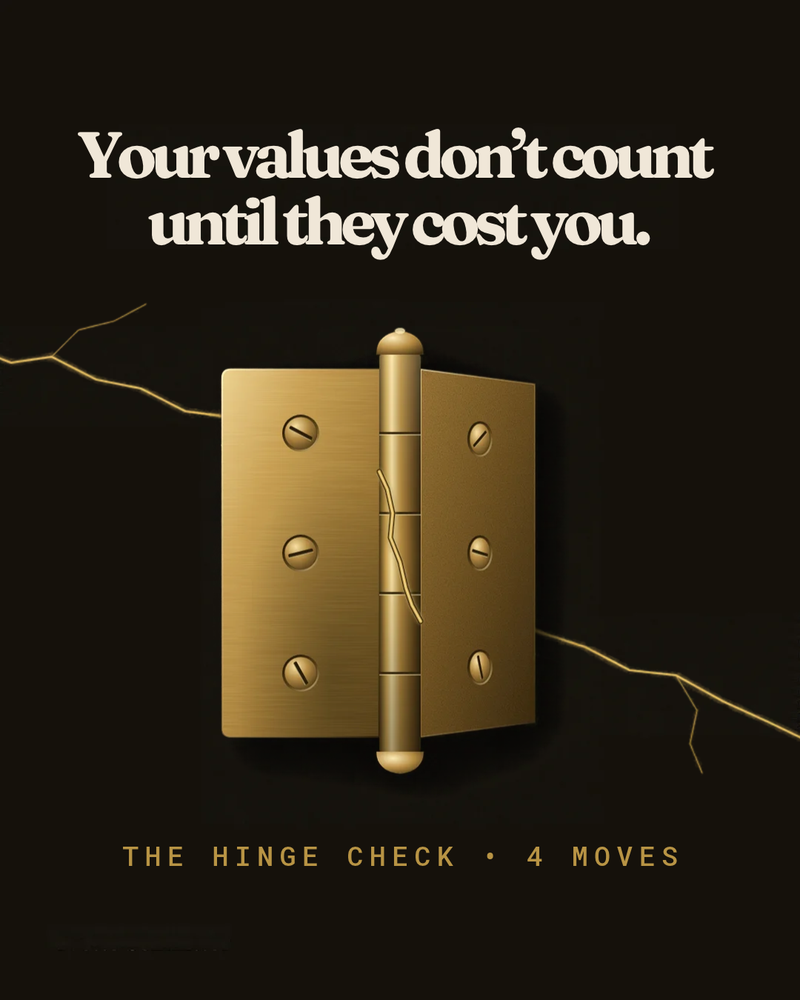
The name is on purpose. The classical world had four cardinal virtues: justice, prudence, temperance and fortitude. I call them justice, wisdom, discipline and courage. "Cardinal" comes from the Latin cardo, a door hinge. They're the hinges the good life hangs on, same as the four points on a compass.
Fusion Compass trains the human. We work on applied skepticism, critical AI judgment, workflow discernment and human accountability, the capacities AI adoption quietly erodes.
Justice is on that compass for a reason. Why?
Because it's about what we owe each other, and that includes the people we'd cross the street to avoid at all costs.
So, sure, the machine can hand you an answer. A person still has to answer for it.
I think of humanness as a skill, and skills fade when somebody else is doing the damn work. I want the people I love to be able to think for themselves, and I also want that for the people I can't stand.
The Hinge Check
Use this before you hand a task to AI, and again before you write off a human being. Four moves, one for each hinge.
- Courage. Have the hard conversation yourself. The dread is usually the sign that it matters.
- Discipline. Write down what you think before you ask the machine what it thinks. Two sentences are more than enough.
- Justice. Take the standard you hold your friends to and try it on someone you dislike. If it only works for your friends, it's a preference. Then ask who gets hurt when you're wrong.
- Wisdom. Ask what doing it yourself gives you. When the answer is nothing, automate it and go enjoy your afternoon.
Give it a week. Start with the person you least want to give it to.
What Does the Other Person Lose?
Shroff's piece ends by asking what you give up when a machine does the work for you. His answer is meaning, and it's a great question to ask.
And I'd stop there if my choices only landed on me, and they rarely do. The same goes for yours.
What if the work you hand over is a decision about somebody else? Now the machine decides who gets the interview, the mortgage, the care and the second chance. Keep following, because the cost now lands on a person who never got a vote, a say, and will never know your name. That's what no skin in the game looks like from the other end.
Ahem. That one's for you, Jensen Huang. You told Ezra Klein you once panicked at a gas pump because you didn't know your ZIP code, and you're totally cool with basic math being forgotten.
I audit these systems, so I've seen what that looks like. I've seen mortgages denied by ZIP code (obviously not Jensen's) and applications rejected over the pattern of a name. The math was flawless, and the humanity was nowhere to be found in the room. The algorithm doesn't know that the single mother working three jobs has more determination than anyone in the building. It sees a credit score of 620 and says deny.
However, the companies running these tools know it, too. When Harvard Business School and Accenture surveyed employers for a 2021 report, 88% said qualified high-skills candidates get screened out for not matching the exact job description. For middle-skills candidates the number was 94%.
And I know, from personal experience, what it feels like from the other side. A machine looked at my photo and decided my face should be somebody else's (of all people Jensen Huang’s). Nobody in that pipeline asked what I'd lose or how I’d feel.
This is the same test I started with, pointed at the machine. My values mean nothing if I only extend them to people I like, and they mean even less if I only extend them to people I can see.
The hardest person to extend dignity to is the one who's been turned into a row of data.
Seneca's line doesn't come with an exemption for software. There's a human being at the other end of every one of these decisions, which makes every one of them an opportunity for a benefit.
Gilgamesh ended up pointing at a wall. The systems we build, and the decisions we hand them, are ours. Somebody is going to walk that wall and inspect the brickwork.
That's why I fight for a human in the loop, and why we keep humans at the nucleus of the work at Fusion Collective. People get it wrong too, me included. But a person can feel the weight of deciding someone else's future, and a person can be made to look that someone in the eye and answer for it. An algorithm sees a pattern. It takes a human to see the person.
So, sure, keep Shroff's question, and ask it every time: "What do I lose if it does?"
Then ask the second one, for the person who isn't in the room:
What does the other person lose if it does?
Be the human in the loop that someone desperately needs you to be.
Share this article
Related Articles

The Reskilling Illusion: When AI Transformation Means "You're Fired"
Oct 03, 2025