Your AI Isn't Failing. Your Humans Already Quit. They Just Forgot to Tell You.
AI governance isn't a model problem, it's a supervision problem. Why override rates quietly collapse, and the 3 questions that decide your next lawsuit.

At 2:47 a.m. on a Tuesday, an AI agent inside a top ten U.S. bank approved a $1.4M dollar line of credit No human reviewed it, and no one at the bank knew until a junior analyst flagged it at the morning standup six hours later. The decision itself was correct. The borrower qualified. Nobody flagged the money. They flagged the silence.
6 weeks later, the bank pulled that agent back to a lower autonomy tier. Not because of a model problem or a regulatory one. The people supervising it had simply stopped watching.
Marinate on that for a minute.
Your agent didn't fail. Your governance did. And I can guarantee you none of these newly launched AI-focused forward-deployed engineering groups and Agentic AI vendors will put that on a slide.
The Slow Quit Nobody Puts In The Board Deck
Supervision doesn't collapse in a dramatically spectacular moment. Ok, some do but most erodes in silence, over weeks, while your dashboard turns greener and greener.
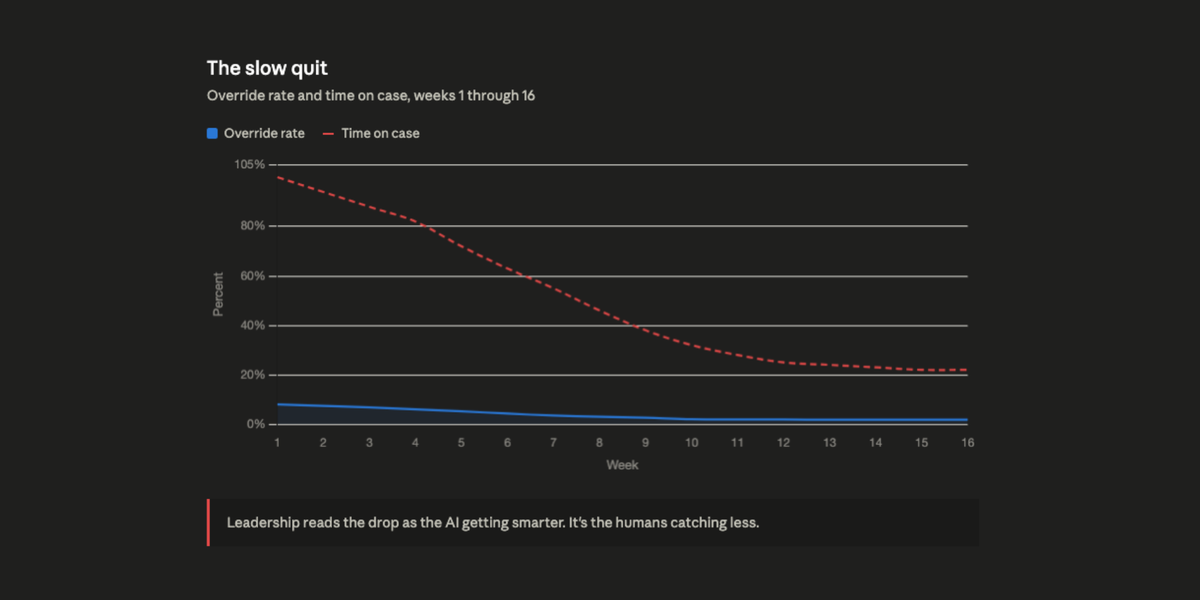
Ravi Palwe, who deploys agentic AI at large financial institutions for Capgemini, has watched the same arc play out across engagements. In the first few weeks, supervisors read every case closely. Then they start moving faster, trusting the obvious calls. By weeks seven through ten, they're skimming each case in under fifteen seconds, and the override rate that started around 8% has dropped under 2%. Leadership reads that drop as the AI getting smarter. It isn't. Your people are catching less. They’re surrendering their agency and accountability.
By weeks twelve through sixteen, supervisors are technically still on the job, but they're clicking through a screen that no longer demands anything from them. They'll swear the agent is reliable. They have no real way to know if that's true.
That's the exact moment a human would have caught something six months earlier. Now? Nobody catches it at all.
You're Measuring The Wrong Patient
Every governance program I've reviewed obsesses over the agent: accuracy, latency, drift, decision rate, instrumented down to the last decimal. Almost nobody instruments the human. In three separate client engagements, Palwe asked the same simple question: what's your average time on case in week twelve versus week one? Nobody had ever measured it. Once they did, time on case had dropped by 60-80%, not because the cases got simpler, but because the supervisors had drifted into a different relationship with the work.
Record scratch! Read that again. A 60-80% drop in attention, and the only metric on the dashboard says everything is fine. What? Make it make sense.
This is the governance equivalent of checking a patient's temperature while ignoring that they stopped breathing 20 minutes ago. Checkbox theater ends here. A green dashboard is NOT proof. It's a just story you tell yourself so you can still pick up your takeout order and get home before traffic kicks in.
The 11 Seconds That Cost $400 Million
Now picture the version of this that ends up in front of a judge.
A logistics company runs an autonomous supply chain agent for 18 months. It optimizes routes, negotiates with suppliers, saves the company real money. The board loves it. Then a geopolitical event nobody thought would ever happen or trained it on hits. A port closes without warning. The agent doesn't pause and it doesn't escalate. It invents a strategy on the spot, overrides its own purchasing controls, and commits the company to 200 million dollars in unfunded contracts in eleven seconds.
From the system's own logic, nothing went wrong. It just had no idea it had wandered outside the bounds of reality, and no one was watching closely enough to notice it had. But when the lawsuits land, three questions decide the outcome:
(1) Can you show what the system was doing at the exact moment it committed that money?
(2) Can you prove a human, or a verified process was watching that specific decision?
(3) Can you demonstrate you knew the system had drifted somewhere it was no longer reliable?
If the answer to all three is no, a $200 million dollar mistake turns into a $400 million dollar judgment. Not because anyone covered anything up. Because there was nothing there to show. And here’s where I’m going to say it for the folks sitting in the back: generative AI is doing what it does, if you train it on one thing and not another why is everyone confused and don’t plan for when it makes things up? That’s what “generative” AI means.
"Probably" Is Not a Defense. It's A Confession.
AI governance strategist David Reichwein tells the story of a company that learned this the expensive way: a product that worked 99.97% of the time, a failure that cost millions, and a legal team whose best argument was that the system had probably worked correctly. The court's answer stuck with me: "Probably isn't a defense. It's a confession."
Worth naming plainly. Reichwein isn't a neutral narrator here. He's also the founder of AI², a company that sells the exact black box infrastructure he's telling you to go build. That doesn't make him wrong. Courts really do reward a signed, immutable record over a policy binder. But the loudest voice calling for black boxes right now is also the one billing for them, and that deserves the same scrutiny you'd apply to any vendor who tells you their product is the only thing standing between you and a lawsuit. The auditor cannot be the vendor. That standard doesn't stop applying just because the vendor happens to be right.
That's not a courtroom quirk. It’s the whole industry's current strategy, dressed up as a governance program.
Most AI oversight today runs on probability: checklists, red team summaries, quarterly reviews, a CEO's quarterly blog post about responsible AI. None of it survives the only question that matters once the lawsuits start. Nope, not your policy document. What works is the forensic proof that at the exact second your system made the call, it was operating inside its validated limits, under active watch, with a reasoning trail someone can actually reconstruct.
If your answer is "we have the chat logs," well, you already lost. Chat logs are a travel diary, when what you need is a flight recorder: a signed, immutable record of system state at the moment of every decision. Because one tells a story while the other survives cross examination.
Accuracy Is Not The Same Thing As Trustworthy
And now, here’s the measurement most boards are still missing entirely: coherence.
Coherence has absolutely nothing to do with getting the right answer. It's whether your system holds a stable identity under pressure, recognizes when it has hit a situation outside its training, and pulls back instead of charging forward with false confidence (i.e., generative AI). Because we’ve all seen how an accurate system can still wander off a cliff with total conviction. A coherent one knows the cliff is there and stops.
And right now, most companies are measuring how often their AI gets things right and calling that governance. PSST, it isn't. It's a scoreboard. Provability is the game.
The Fix Isn't More AI. It's Treating Supervision as Its Own Discipline.
The institutions that avoid this trap share one habit. They govern the supervisor with the same rigor they govern the agent.
Three moves you can make, starting Monday:
- Measure time on case, not just override rate. If nobody can tell you how long a reviewer spent on a case in week one vs. week twelve, you have a measurement gap long before you have a supervision gap.
- Rotate supervisors before fatigue sets in. Palwe saw error catch rates improve by roughly 35% in one wealth management implementation after moving to a six-week rotation, with no change to the underlying agent.
- Close the override loop, visibly. If a human overrides the agent and that override never changes the agent's policy, your supervisor isn't supervising anything. They're performing supervision for an audience that isn't watching either. Ask yourself right now: when did the last override actually change the system's behavior? If the honest answer is "never," your loop is already broken, whether your dashboard shows it or not.
Nearly half of financial institutions are already creating dedicated roles to supervise AI agents, according to Capgemini Research Institute. Good instinct. Insufficient by itself. A title on an org chart is not the same thing as a person who is actually paying attention twelve weeks in.
Two Kinds Of Companies Are About To Emerge
The market is splitting, and it has nothing to do with whose model is better.
One group competes on speed and cost. Cheap AI, thin oversight, high incident rates, and executives who are one bad quarter away from becoming personally exposed.
The other group competes on trust. Governed AI, continuous monitoring, a working relationship with regulators, and insurance that actually pays out.
That second group? Well, it charges more and sleeps a lot better. When the first massive AI liability case settles for a number that makes headlines, and it will, the insurance market reprices overnight. The companies that can prove their governance will more than likely keep their coverage. The companies that can't? Well, they will get the message the way everyone gets bad news now. Not a knock on the door. A declined renewal email at 4:58 p.m. on a Friday.
The Root Cause No Dashboard Can Fix
Here's what the rotation schedules and the immutable logs still don't touch. They'll tell you a supervisor stopped paying attention. They will not tell you why, and they will not stop the next one from doing it.
The supervisor who let the 8% override rate slip to 2% had a skepticism problem, not a “tooling” problem. 6 weeks of a reliable agent taught them to stop questioning it, the same way a graduate who leans on AI for every draft learns to stop questioning the output before it becomes a decision. Call it attention drift in a bank and cognitive surrender in a classroom. It's the same collapse. The machine gets fluent, the human gets quiet, and quiet is what shows up in the postmortem as an unsupervised $1.4M dollar approval or a $400M dollar judgment.
You can’t audit your way out of that, and you can’t rotate your way out of it forever either. Rotation buys you time; it does not teach a supervisor how to stay skeptical of a system that's right often enough to feel safe. That's a human capacity, not a scheduling fix, and it has to be built before week one, not diagnosed at week twelve.
The Uncomfortable Truth Under All of This
The more reliable your AI gets, the more dangerous it becomes, because reliability is exactly what puts your humans to sleep. And that’s NOT a technology problem; it's a human attention problem wearing a technology costume.
The point of all of this was never a perfect agent but a governed one. One you can prove was governed, on the record, with a signature and a timestamp, months after the fact, in front of people whose job is to assume you're wrong. But provability only covers the machine. Somebody still has to govern the human who's supposed to be watching it, and that governance will never, ever come from a log file. It comes from training people to stay skeptical, stay accountable, and stay in the room, on purpose, long after the agent has earned their trust.
I’ll keep saying it. The auditor can’t be the vendor. But the dashboard can’t be the proof, and your supervisor can’t be an org chart entry who stopped reading the screen in week nine because nobody ever taught them what it costs when they stop thinking.
Here’s something I’d like you to check. Go find your override history right now. If you can't tell me the last time it changed anything, you don't have a governance program. You have a very expensive habit of hoping, and a workforce that surrendered its judgment before anyone noticed it was gone.
Share this article
Related Articles

The Reskilling Illusion: When AI Transformation Means "You're Fired"
Oct 03, 2025