You Have AI Agents You Cannot Name. Now Look at the Bill.
A company spent $500M on AI in one month by accident. No caps, no owner, no warning. Here's how to meter your agents before the bill does.

Here’s a question: answer one question about your own company.
How many AI agents are running inside it right now, who owns each one, and what are they spending?
You can’t answer it. Almost no leader can.
While you read this, agents are reading your data, drafting your emails, moving records, and billing you by the token for every step.
I’ve been hearing this and reading about the bills for weeks. The bills are here and they are huge.
Uber burned through its entire 2026 AI coding budget in 4 months. This is fine if you got a year’s worth of stuff in record time. They didn’t. Engineers were running Claude Code and Cursor at $500 to $2,000 dollars each per month, until the company capped it at $1,500 dollars per tool per person and built a dashboard so people could watch the meter.
And these aren’t rounding errors. No, they are all that productivity you bought, priced by consumption, with no governor on the throttle. And the vendors are turning the same screw.
GitHub moved Copilot to usage-based billing on June 1st and heavy users watched projected monthly bills jump from $39 dollars to more than $800, and some drained a month of credits in a single day. Cursor's switch to consumption pricing emptied one team's $7,000-dollar annual plan in a single day.
Flat became metered. Unlimited became conditional.
None of this by accident and it is about to get much worse. A Michigan pension fund just sued Microsoft, alleging it masked the true cost of its AI build-out behind Copilot optimism while Azure growth quietly slowed. Whatever the merits, here’s the part that matters to you. The companies selling you AI are under real pressure to turn it into revenue and that pressure runs straight into your contract. The cost risk is moving off their books and straight into yours.
If you think cutting your token spend will save your AI budget, you are wrong. All you are doing is hiding where it’s hemorrhaging.
Now stack that next to what you cannot see. Microsoft's Cyber Pulse report, built from its own telemetry, found more than 80% of the Fortune 500 running active agents. In a survey of 1,700 data security leaders, 29% of employees admitted to using agents nobody approved. A single coding agent can take one request and fire off dozens of model calls behind it, each one burning tokens, while the employee sees a single task box on screen. To finance, it looks like a meter someone left running.
Not only can’t you name the agent, but you also can’t explain the bill. Same gap, two faces.
Leaders are feeling all of it. BCG reports that 58 % of the heaviest adopters expect a fundamental change to governance and decision rights within three years. The machines are taking ground, the bills are climbing, and most companies are reaching for the only lever they recognize. Rationing tokens!
And that’s the trap.
If you starve the tooling you lose the productivity you were paying for. Sure, you will have reduced cost and value in equal measure and called it discipline. Uber's own COO is now asking out loud whether all that spend maps to anything customers feel. Which is the right question, and rationing doesn’t answer it – at all.
The answer is Governance Done Right and let me tell what it’s not. It’s not a tax on AI adoption but ties every dollar of spend to a measurable outcome. It surfaces the consumption that produces nothing and hands you the evidence to defend or kill a line item before finance does it for you. And this is how you walk into the next contract negotiation knowing exactly what you are buying. The cheat code? Calibration. Calibration is the whole game.
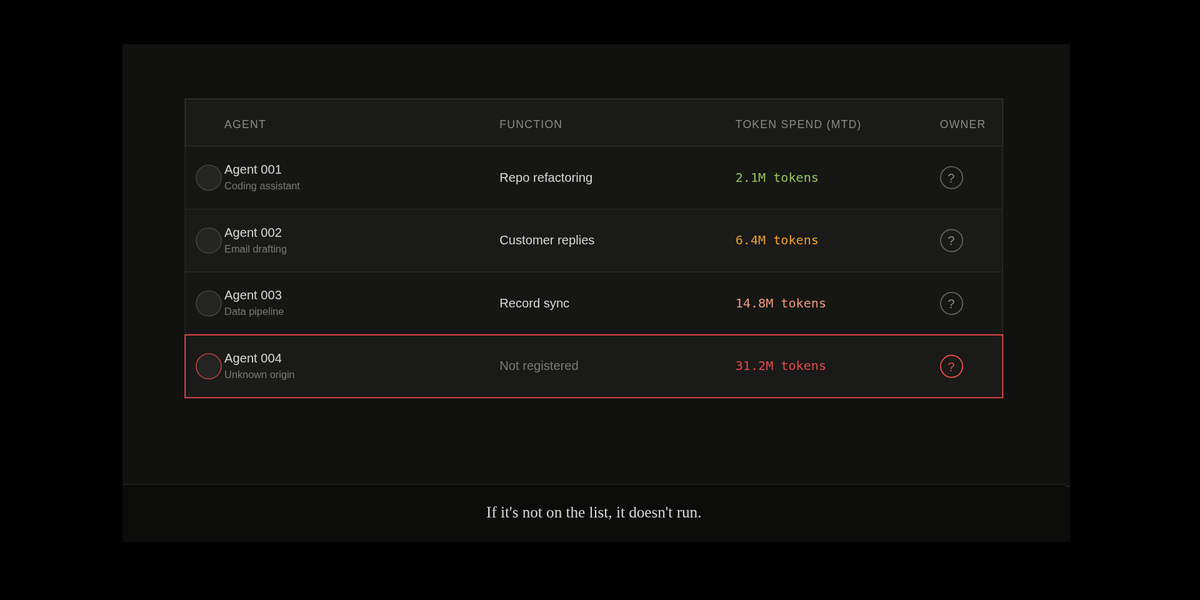
This is the same discipline pointed at the bill. Build an agent registry. One list. Every agent, sanctioned, third-party, and shadow. If it’s not on the list, it doesn’t run. Assign a named human to every agent. Just like the Seinfeld “No Soup For You” episode. No owner, no run, no budget. Apply least privilege, which is also least spend. An agent that can only touch what its job requires can’t run up tokens on work nobody asked for. The registry that secures you is the registry that meters you.
And when you are ready to cut, cut with proof. That’s why we built Token Optimization at Fusion Collective. Anyone can make a model cheaper by making it worse. The hard part, and the only part worth paying for, is cutting spend while proving quality held.
We measure every token by feature, model, and tenant, not as one monthly lump. We find the waste: bloated prompts, an over-powered model on a trivial task, an uncached prefix, output nobody bounded. We pull the cheapest-risk levers first. Then Fusion Sentinel runs every change old against new on your real inputs and ships it only if quality stays inside tolerance. The proof is the deliverable.
You can start this today. Count your agents and name their owners. Meter your spend by feature and model. Find the consumption that produces nothing and cut it with evidence behind you. Then renegotiate your contracts from knowledge instead of picking up everything vendors throw down as fact.
The organizations that continue to treat governance as zero value and time suck paperwork that delays getting things done are about to learn the hard way what it costs them. The ones that built it as infrastructure are about to collect the dividend.
Calibration is the whole game. Run the numbers before your vendor runs them for you.
Share this article
Related Articles

The Reskilling Illusion: When AI Transformation Means "You're Fired"
Oct 03, 2025