The Car Is Watching You. Does It See All of You?

Your new car is now required by law to read your face. The question nobody is testing is: whose face it reads well.
Since July 2024, every new vehicle type sold in the European Union has had to watch the person behind the wheel. A camera, pointed at your face, judging whether you are drowsy, whether you are paying attention, whether your eyes have drifted from the road. This is not a luxury feature or a future concept. It is the law. The EU General Safety Regulation mandates Driver Drowsiness and Attention Warning systems in all new vehicles, and from July 2026 it extends the Advanced Driver Distraction Warning requirement to every newly registered car on the market.
The intent is good. Fatigue and distraction cause a large share of road deaths, and a system that catches a nodding head or a wandering gaze can save a life.
I’m not here to argue against safety; I’m here to ask the question that turns a safety feature into a justice question.
These systems work by reading human faces. And we have known for years that machines reading human faces do not read every face equally or correctly.
The point we already know, and keep ignoring
The evidence on facial analysis is not new nor is it subtle.
- Performance shifts with skin tone.
- It shifts with eyewear.
- It shifts with head coverings.
- It shifts with lighting, with age, with the shape of features the training data underrepresented or completely excludes.
This is one of the most documented failure patterns in computer vision, established across years of peer-reviewed work.
Now place that failure pattern inside a safety system that is mandatory. Think about what unequal performance means here. If a drowsiness detector is less reliable at recognizing fatigue on darker skin, then the people it protects least are exactly the people the law promised to protect equally. If a distraction system throws more false alarms at a driver in a head covering or a driver wearing glasses, that driver gets nagged, doubted, and worn down by a machine that trusts them less. One failure is a missed warning. The other is a daily insult delivered at sixty miles an hour. Both are inequities written into a system YOU can’t opt out of.
This is what makes in-cabin monitoring different from the face-unlock on your phone. You can choose a passcode instead. You can’t choose a different car than the one the regulation built.
The gap isn’t the bias. The gap is that nobody tests for it.
The standards exist to make sure these systems work. They don’t exist to make sure these systems work for everyone.
Type-approval under the General Safety Regulation checks that a driver-monitoring system detects drowsiness and distraction. The new AI safety guidance for road vehicles, ISO/PAS 8800, addresses whether AI in a vehicle behaves safely. Both are real progress but neither requires a manufacturer to prove that detection holds up evenly across skin tone, across eyewear, across head coverings, across the full range of humans who could sit in that seat.
Even the research community sees the hole and walks past it. Read the academic literature on in-cabin systems and you’ll find a recurring theme: these systems should be evaluated for performance differences across demographic groups. Should. Not must.
Not here is the test, not here is the threshold you have to clear. A system today can pass every legal requirement, ship in millions of cars, and quietly perform worse for some drivers than others, and no rule in place would ever catch it.
And here’s the part that should make you trust the claims even less. These are systems whose makers largely get to report their own safety performance. We have just watched what THAT can look like. According to Reuters, Tesla presented self-published safety statistics to European regulators while seeking approval for its Full Self-Driving system, including a claim that the system could have prevented tens of thousands of deaths. Independent researchers said the number depended on assuming every vehicle in America, trucks and motorcycles included, was replaced by one of the company's cars. Reuters reported that 10 of the 11 researchers it consulted called the method misleading marketing. Tesla did not respond to the news agency, and the regulators say they ran their own testing.
The name on the car really doesn’t matter because this isn’t about one company. The pattern IS the point.
When a maker reports its own safety numbers, the numbers tend to flatter the maker. A watchdog at the European Transport Safety Council said the remedy out loud, that real safety claims go to a university and get verified by a qualified researcher before anyone takes them seriously. Now, sit with what that actually means for the cabin camera. If we can’t take a self-reported safety average on trust, we have no business taking an unverified fairness claim on trust. And right now, fairness isn’t even being claimed. It is simply being skipped.
And that’s the unanswered question.
Not whether bias in driver monitoring is possible; because we know it is. The question is what a real, production-grade fairness test looks like for a safety system that watches faces, and why no one has been required to build one.
What the test should be
This is solvable. It’s not even exotic. It just has to be demanded.
A real fairness acceptance test for driver monitoring stratifies the people its tested on. This isn’t a single accuracy number across a convenient sample, but performance measured across skin tone, across eyewear, across head coverings, across age, across the lighting conditions of a real cabin at dawn and at dusk and at night. Performance measured across the diaspora of people, places and things that make up real life. Not lab life, real life; warts and all. Because it measures two things that matter most: how often the system misses a real safety event for each group, and the missed detections and how often it fires a false alarm for each group. Those outputs set a parity threshold, a defined limit on how far performance is allowed to diverge between groups and treats that threshold as a gate the system must pass before it ships. Not a research footnote. An acceptance test, run independently, with consequences for failing.
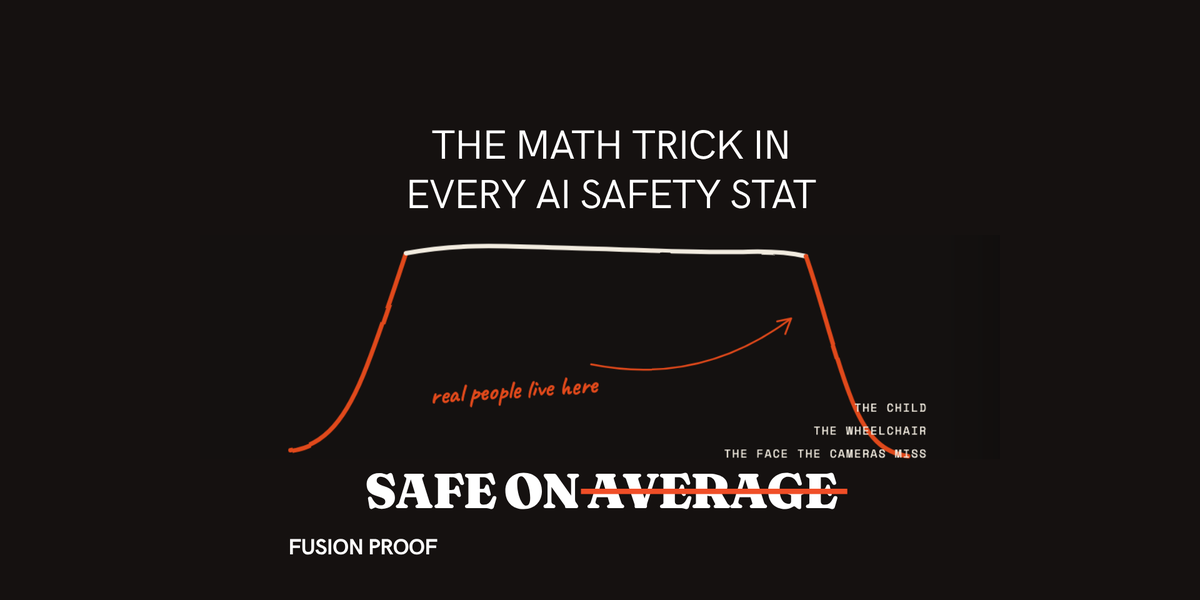
This is the difference between a system that works on average and a system that works for all people. Average is how you end up protecting some drivers and surveilling others with the same camera.
If you build these systems or buy them
- For the practitioners, the engineers and the suppliers and the safety leads, the ask is concrete. Demand stratified performance data from your driver-monitoring vendor, not a single headline accuracy figure. Ask for missed-detection and false-alarm rates broken out by skin tone, eyewear, and head covering. If a supplier cannot produce that breakdown, you have a marketing claim, not a safety claim. Make the parity test part of acceptance, before the system reaches a customer.
- For everyone else, the people who will simply get in the car, the takeaway is your right to ask. When a salesperson tells you the vehicle monitors your attention for your safety, it’s 100% fair to ask this next question. Was it tested on people who look like me? You deserve a yes you can trust.
The promise of these systems is that the car is looking out for you.
But that promise only holds if the car can see YOU. A safety system that sees some people more clearly than others isn’t neutral technology that happens to have a flaw. It’s a decision about whose safety counts, made in code, shipped at scale, and protected by the fact that no one is required to check.
And until the fairness test is mandatory, the burden of being seen falls on the people the machine was trained to overlook, and that is a burden no driver agreed to carry. Technology should catch up to the human. All humans.
A safety system that sees some people more clearly than others isn’t neutral technology that happens to have a flaw. It’s a decision about whose safety counts, made in code, shipped at scale, and protected by the fact that no one is required to check.
And until the fairness test is mandatory, the burden of being seen falls on the people the machine was trained to overlook, and that is a burden no driver agreed to carry.
Technology should catch up to the human. All humans.
Share this article
Related Articles

The Reskilling Illusion: When AI Transformation Means "You're Fired"
Oct 03, 2025